Active Recall vs Passive Review: The Secret to Remembering Vocabulary 10x Faster
Have you ever spent an entire evening highlighting a vocabulary textbook, feeling confident, only to forget almost every word the next morning?
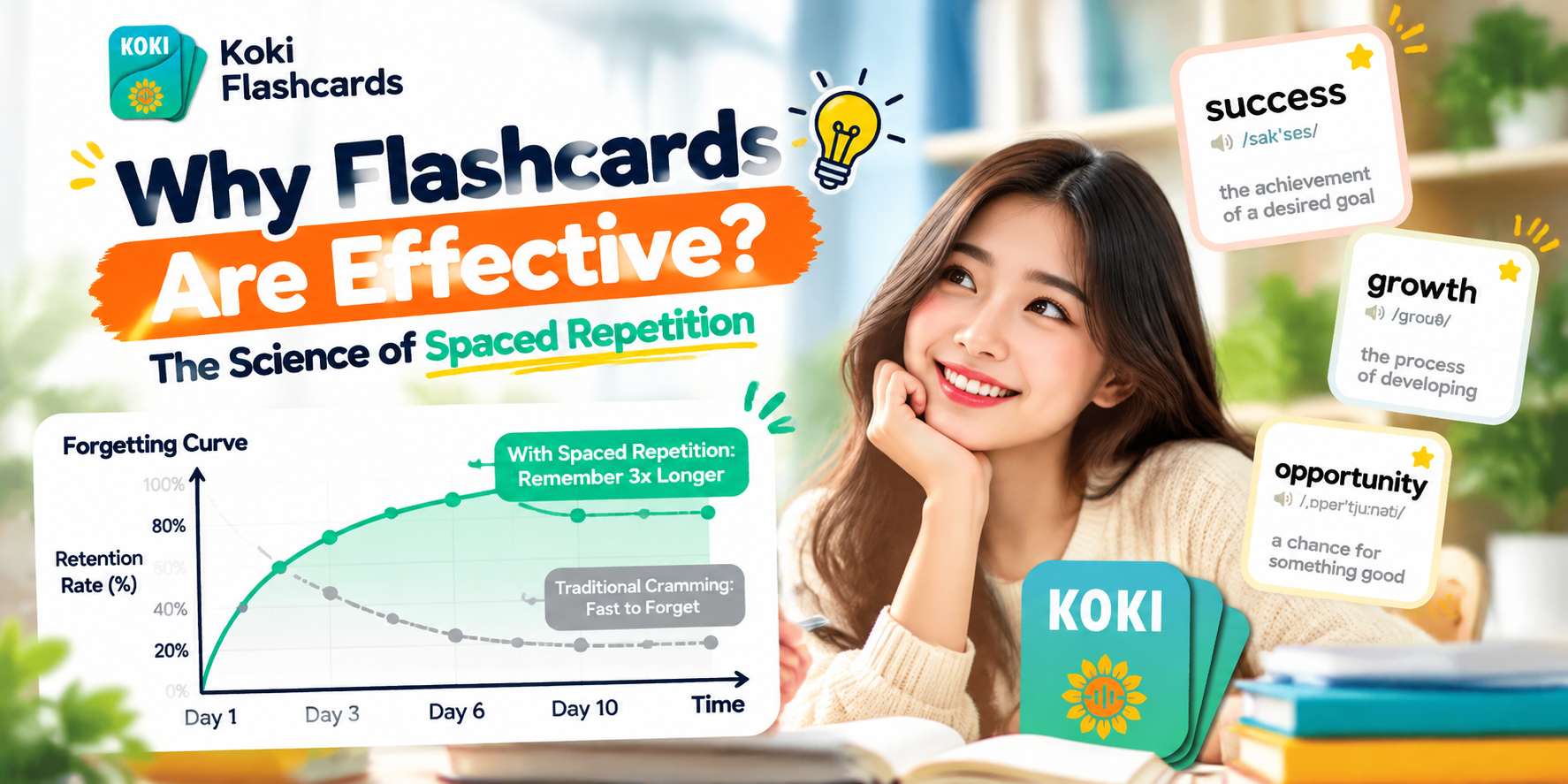
This common frustration comes from relying on passive studying. Rereading notes, highlighting definitions, and watching videos feel comfortable, but they do very little to lock information into long-term memory.
When comparing active recall vs passive review, cognitive scientists agree that challenging your brain to retrieve knowledge produces far superior retention. Here is why active recall works and how Koki Flashcards helps you apply it effortlessly.
The Illusion of Competence in Passive Review
Passive review happens whenever information is directly presented to your eyes.
When you look at a vocabulary word with its definition already visible beside it, your brain says, “I know that.” However, recognizing information when it is in front of you is completely different from producing it from memory.
This phenomenon is called the illusion of competence. You feel like you are learning, but your brain is merely recognizing patterns without building strong neural pathways. When exam day arrives, or when a conversation begins, your brain cannot retrieve the word independently.
Why Active Recall for Language Learning Is Superior
Active recall requires you to retrieve information from memory without looking at the answer first.
Using active recall for language learning provides three major advantages:
- Stronger Synaptic Connections: The mental effort required to pull an answer from memory strengthens neural pathways, making future retrieval faster.
- Instant Gap Identification: You immediately discover what you truly know and which terms need more work.
- Real-World Fluency: Speaking and writing require spontaneous word production; practicing recall trains the exact reflex you need in conversation.
Forced retrieval is undeniably the best way to remember vocabulary permanently.
How Koki Flashcards Automates Active Recall
Koki transforms every study session into a series of active retrieval challenges:
1. One-Sided Card Display with Hidden Hints
Koki flashcards show you only the question prompt or target character first. Tap the Clover icon to hide phonetic guides or Pinyin, forcing your brain to retrieve the pronunciation and meaning before checking the back.
2. Fast Known and UnKnown Swiping
Be honest with your memory. Swipe left for UnKnown if you struggled to retrieve a word, or right for Known if recall was instant. Koki automatically brings difficult cards back in upcoming rounds while mastered words rest.
3. Interactive Quiz & Writing Checks
Take active recall further by switching to Writing mode to type out words letter by letter, or play Fill-in-the-Blank quizzes to prove you can retrieve terms in context.
Stop Rereading and Start Testing Yourself
Highlighting notebooks creates an illusion of progress, but active retrieval creates true fluency.
Understanding active recall vs passive review will change how you study forever. By testing yourself consistently and reviewing in short rounds, you save hours of study time while doubling your retention.
Download Koki Flashcards today and experience the power of active recall on your daily vocabulary goals!